
Austria Closes Its Borders — and Von der Leyen Is Reportedly Panicking
A sudden policy move by Austria to tighten and effectively close its borders has triggered renewed debate within the European Union, placing migration policy and the principle of free movement under intensified scrutiny. The development, highlighted in widely shared commentary and amplified by a strongly worded caption, has drawn particular attention to the position of Ursula von der Leyen and the broader response from Brussels.

According to the available description, Austria’s decision represents a significant departure from established EU norms, particularly those associated with open borders and coordinated migration management. While specific operational details are not provided in the transcript material, the move is framed as both abrupt and consequential, prompting concern among EU officials.
The commentary suggests that the decision has generated unease within European institutions, with implications that it could challenge the cohesion of existing migration frameworks. The principle of collective responsibility—central to EU migration policy—appears to be at the heart of the emerging tension.
Critics, as reflected in the caption, interpret Austria’s actions as a direct challenge to Brussels’ authority. The argument presented is that unilateral border controls risk undermining a system built on shared rules and mutual trust. This perspective emphasizes the potential for fragmentation if individual member states adopt independent approaches.
At the same time, the narrative points to internal pressures within member states, suggesting that domestic political considerations may be driving such decisions. Although the transcript does not elaborate on Austria’s official justification, the broader implication is that national governments are responding to public concerns that may not be fully addressed at the EU level.
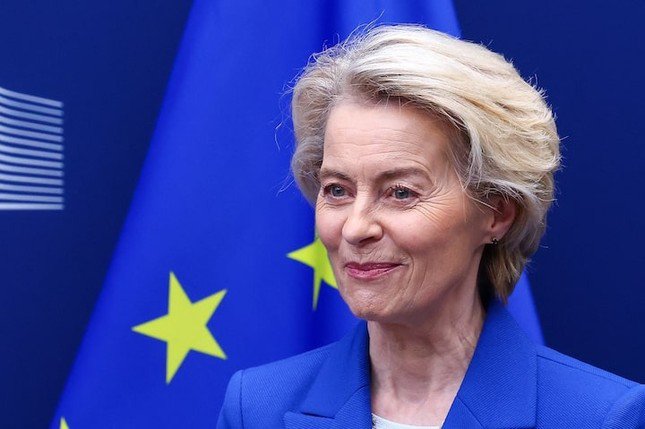
The reaction attributed to von der Leyen’s leadership is described as urgent, though no direct statements or policy responses are included in the provided material. Instead, the focus remains on the perceived strategic challenge posed by Austria’s move and the possibility of wider repercussions.
One key concern raised is the potential for a “domino effect,” whereby other countries facing similar pressures might follow Austria’s example. This scenario, while speculative in the absence of concrete evidence, underscores anxieties about the durability of EU-wide agreements in the face of national policy divergence.
The tension highlighted in the discussion reflects a longstanding debate within the EU: the balance between national sovereignty and supranational coordination. Austria’s reported actions are positioned as a case study in how quickly that balance can come under strain.
From a policy standpoint, the situation raises questions about enforcement mechanisms within the EU. If member states choose to deviate from agreed frameworks, the extent to which Brussels can respond effectively becomes a central issue. The transcript, however, does not provide details on any formal measures being considered.
The accompanying caption amplifies the sense of urgency and political significance, portraying the development as a potential turning point. While such framing reflects heightened public interest, it also illustrates how migration policy continues to be a focal point for broader debates about the future direction of the European Union.
Importantly, the absence of detailed transcript evidence limits the ability to assess the full scope of the situation. Key elements—such as Austria’s official rationale, the precise nature of the border measures, and the formal response from EU institutions—remain unspecified in the material provided.
In conclusion, Austria’s reported decision to tighten its borders has become a focal point for wider concerns about EU unity and migration governance. While the commentary and caption suggest significant implications, the lack of comprehensive information means that many aspects of the situation remain unclear. As a result, the issue continues to generate debate, with its longer-term impact on European policy and cohesion still unresolved.